

Inside Lincoln Center With Shanta Thake
Notes from a morning at Lincoln Center with Shanta Thake
There is a gold record on the wall of Shanta Thake's office. Adele, 19. A few feet away, a framed poster from The Public Theater. Around the room: paintings, prints, a citation under glass, objects that look less like decoration than like evidence — of shows made, rooms filled, careers begun.
I had come to Lincoln Center to begin something. The New York season of The Art Career starts here, and it starts with Shanta because she sits at the center of the question I most wanted to ask this year: what is culture actually for, right now?
Shanta Thake is the Chief Artistic Officer of Lincoln Center. Before that, she spent more than a decade at The Public Theater, where she ran Joe's Pub — the downtown room where an enormous number of American artists first found an audience. It is a rare path. Most people who end up steering an institution of this size arrive from boardrooms. She arrived from the room where the work happens, and you can feel that in how she talks.
We sat across a small table with two microphones between us. What follows are a few things I haven't stopped thinking about since.
On why any of this matters.
Early in our conversation, I asked what energizes her about the work. She didn't reach for policy or attendance figures. She said this:
"I know that it's one of the only tools we have to move us forward in a positive direction, and in a way that allows us to see one another — and to feel like the embodied humans that we are."
Embodied. That word has stayed with me. We are living through a period in which nearly everything has been flattened into a screen, and here is a person whose entire job is to insist that some things only happen when bodies are in a room together. Not as nostalgia. As a tool. As something we need — which is a much harder and more interesting claim than "the arts are nice."
On making room for the unfinished.
One of the things I found most surprising is Lincoln Center's Collider Fellowship. Six artists, working at the vanguard of their fields, are given nine months to explore how technology might deepen — not replace — the experience of being in a room watching live performance. They get studio space at Lincoln Center and at Onassis ONX, stipends, staff support, and each other.
What they are not given is a deadline for a product. No required final piece. No commission to deliver.
I think about how rare that is. Institutions are built to produce outcomes; funding usually arrives attached to a thing that must be made. To hold space for genuine investigation — for the possibility that the most valuable result is a question rather than an object — is a real act of institutional courage. It also tells you something about how Shanta thinks. You don't design a program like that unless you actually trust artists.
Walking out through the plaza afterward — past the fountain, past people eating lunch on the steps who had no particular reason to be there except that it's a good place to be — I kept thinking about that word again. Embodied. All of this exists so that people can be somewhere, together, in front of something made by another human being.
That's the season we're making. New York, up close: the institutions, the artists, the critics, and the people quietly deciding what our culture becomes.
It begins here.
The full conversation with Shanta Thake is available now on the podcast and YouTube.
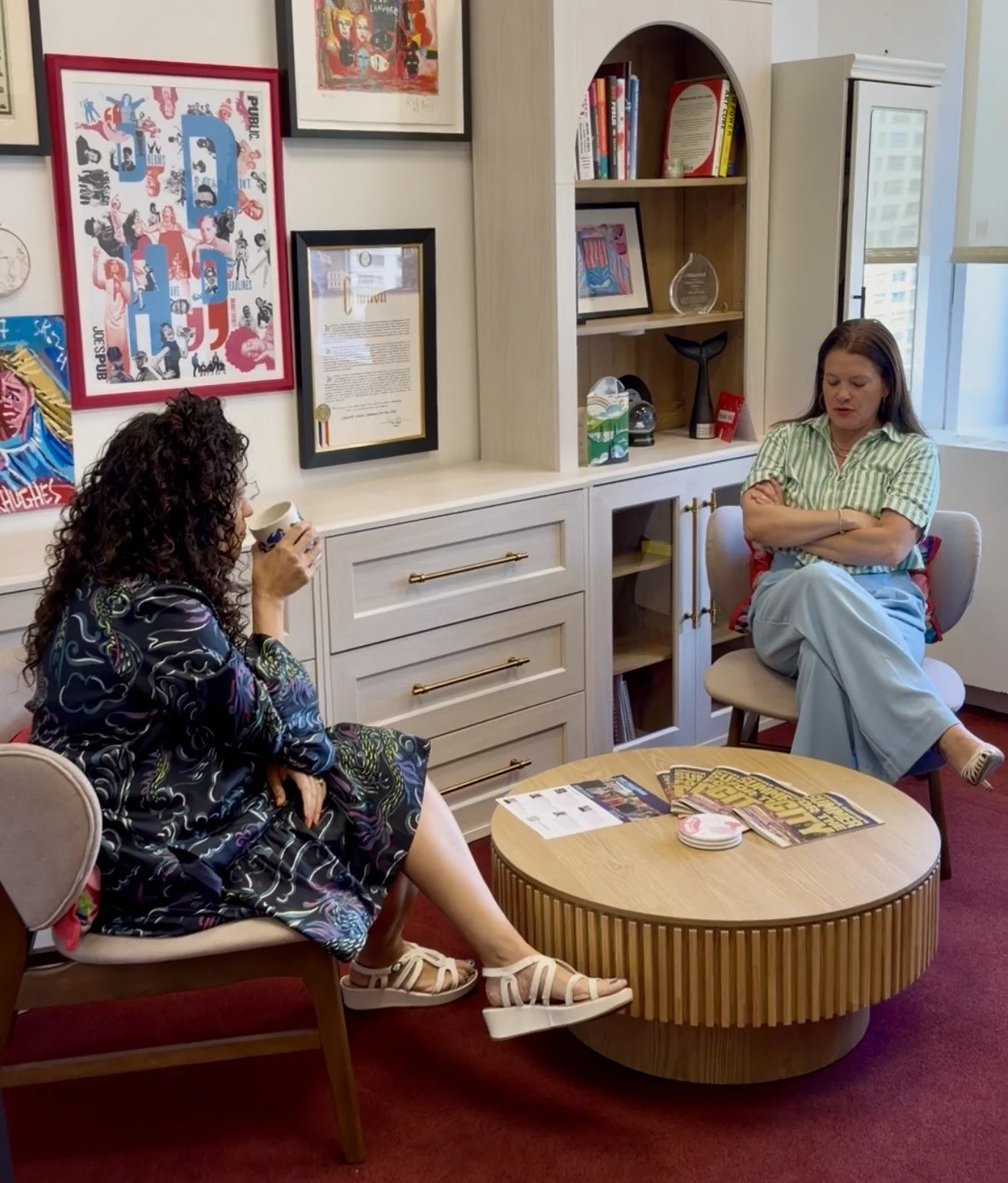
Shanta Thake and Emily McElwreath at Lincoln Center